

2026 Forty Under 40 Alum of the Year:
Scott Raecker
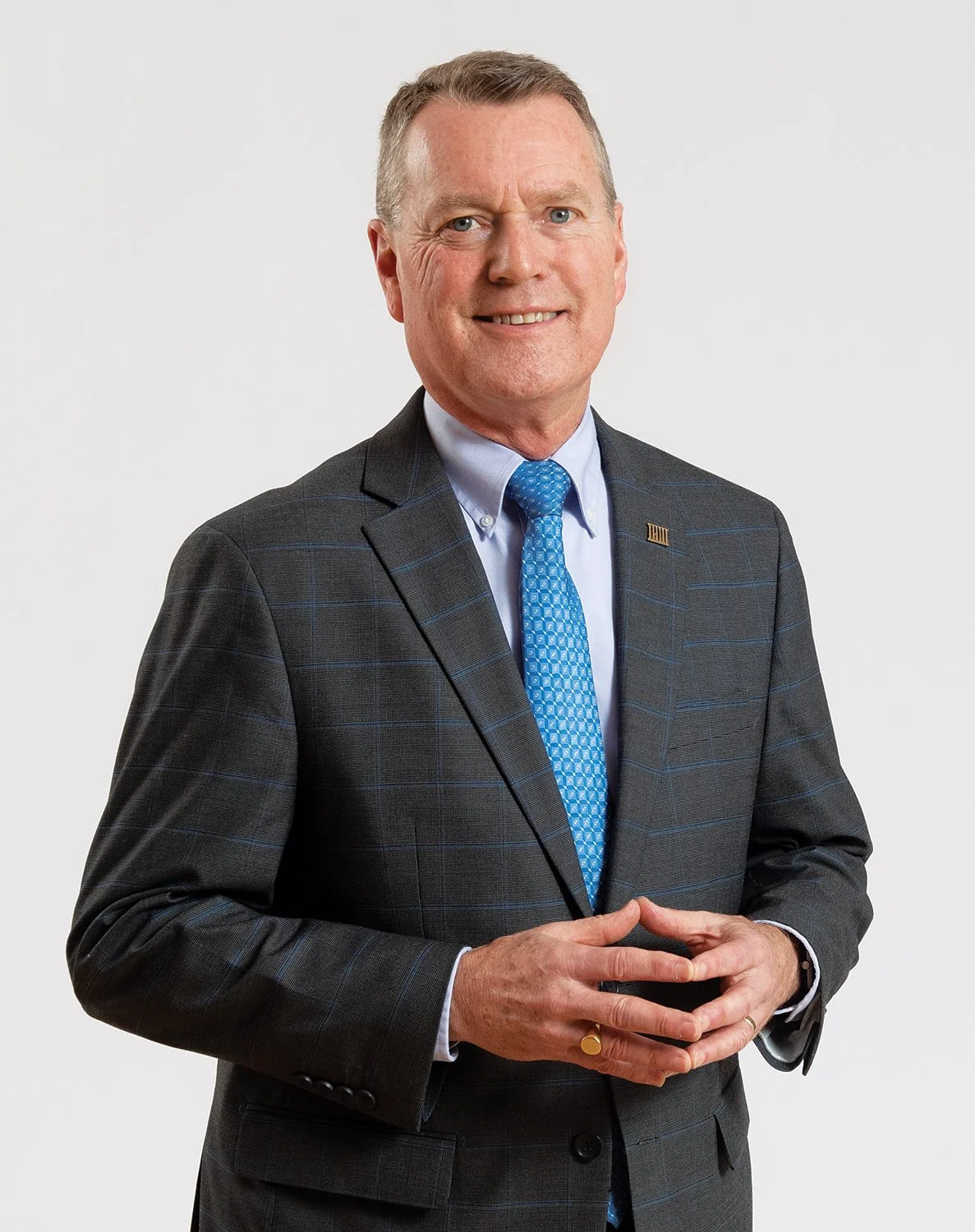
Photo by Duane Tinkey
Scott Raecker has spent much of his career working to strengthen the civic fabric of communities.
For nearly three decades, Raecker has led the Robert D. and Billie Ray Center at Drake University, where the focus is promoting civility, character development and ethical leadership. The center traces its roots to Iowa’s 1996 sesquicentennial celebration, when former Gov. Robert D. Ray envisioned a lasting legacy that would help elevate the character and civic engagement of Iowans.
That effort grew into the Ray Center’s work today, which includes the global Character Counts initiative and programs that now reach millions of young people worldwide.
Raecker’s career has also included 14 years in the Iowa House of Representatives, where he served in several leadership roles, including chair of the House Appropriations Committee.
The Business Record is proud to recognize Raecker as the 2026 Forty Under 40 Alum of the Year. He was honored as part of the Forty Under 40 Class of 2001.
The following Q&A with Raecker has been edited and condensed for clarity.
You spent decades working at the intersection of leadership, public service and character education. When you look back, what feels like the common thread tying it all together?
For me, I think the common thread is mission drive and impact in the lives of others in each of those arenas. I’ve always gravitated toward things that are cause related. Can I get up today and in what I do see that I have made a difference in the world? And that might be an individual life to a more collective opportunity. It’s more than words on a wall, and it’s in our vision statement at the Ray Center. It’s the inspiration statement of Drake University, and that is to transform lives and strengthen communities. So an intersecting point for me, I think in any role I’ve been, whether it be professional career pursuit, public service or humanitarian philanthropy, is this common mission-driven, cause-related, purpose-related: Am I transforming lives and strengthening communities? I’ve never really felt, even in the work that I do now, that it’s a job. It’s a calling; I feel called that I can make a difference in the work today, in our mission to improve civility through character development and ethical leadership.
The Robert D. and Billie Ray Center was founded as a legacy project tied to Iowa’s sesquicentennial. So how has its mission evolved as the needs of civic life have changed?
The mission of the legacy was to recognize, enhance and sustain the positive qualities of Iowans in order to promote civility through character development and ethical leadership. We started in 1997 with one fifth-grade classroom in Iowa using the Six Pillars of Character: trustworthiness, respect, responsibility, fairness, caring and good citizenship, core values that are universal. In the first 10 years of our operation, we trained over 50,000 Iowa educators and community leaders in the Character Counts framework and became a preeminent state in the country in the Character Counts initiative. In 2015, what was the independent nonprofit that was created as the legacy, which had been from its founding attached to Drake University, became a center at Drake University. The Drake University evolutionary statement was for us to become a global resource in the areas of civility, character development and ethical leadership. In July 2019, the Ray Center acquired the global rights and responsibilities to Character Counts and we now serve over 9 million youths worldwide. The evolution of our work, which started with Gov. Ray’s vision of impact in Iowa and focused on youth, from one elementary classroom growing to 9 million youths is also impacting state legislative leaders across the country, as well as having impact in communities and workplaces through culture-shaping to create a better opportunity for us to interact and thrive in our pursuits.
Will you share about the importance of civility in everyday life?
When we talk about civility, the foundation of civility, the floor is courtesy, decency, respect, kindness and decorum in the public arena. Those should just be givens. The depth of civility we’re trying to get to is, ‘How do we disagree without being disagreeable? How can we have hard, challenging and difficult conversations on items that we don’t necessarily agree on potentially to seek at least understanding, if not resolution.’ It’s really important for people to understand when we’re talking about civility, this is not just, ‘Hey, let’s just be nice to each other.’ We should be nice to each other. We should be kind. But what we’re really trying to get to is, ‘How do we equip people at all levels to work better together, to utilize this concept of civility to move us forward in any challenging and difficult decision.’
What do you want people to understand about Character Counts?
Character Counts is not a program, it is a way of life. The Six Pillars of Character are life skills that are important in every stage of our lives. Character Counts provides character education and leadership development resources to improve civility and produce meaningful, measurable and sustainable results in our schools, organizations, families and communities. Character Counts helps shape the character competencies that are developed in us through a variety of life experiences that help create strong, vibrant communities that value positive, healthy relationships and respectful behavior. When it comes to issues of character, ethical leadership and civility, you don’t need to be sick to get better, and all of us can get better. There is not a perfect person. There’s not a perfect organization. That doesn’t mean we can’t strive to emulate what we want to see, the best in ourselves and the best in others. Our character counts everywhere all the time.
When you were serving in the Iowa House, what lessons from that era feel especially relevant now?
Serving in the public arena is a noble and honorable pursuit and probably one of the highest honors in my life that people elected me to represent them at the Capitol. One of the experiences I think any person that served would acknowledge, and I think it’s part of leadership overall, is the significance of building intentional relationships. And while the tone and the tenor may have changed, there are still Democrats and Republicans working together on issues that are important to the state. There’s still a legislative body here in Iowa and across the country of really well-intentioned people wanting to do good and right for their states. The intentionality of building relationships with people that are new and different was critical then, and it’s critical now. The ability to actively listen to people that have different opinions and thoughts on issues of significance. It was important then and important now to seek to understand as well as be understood. We’ve become a society that is 30-second sound bites, 160-character [posts], and we have to be intentional about building relationships. The lessons of public service that I believe are timeless are relationships, clear communication and accountability.
With some of the polarization in the country right now, where do you see real opportunities for progress?
I look for opportunities for progress every day and in every interaction. How do you change the world? One person, one decision at a time. Opportunities are in every community and every organization. And it’s not just opportunities for those that are in elected office or those that are in politics or campaigning. The opportunity for growth lies within each and every one of us. The most important person in the entire process of good governance is the informed and educated citizen. I believe to my core that people are good. We have polarization that has evolved into really challenging, horrific things. But I am going to be part of the solution of trying to equip people with tools and strategies to elevate our civility and how we interact with each other. And it’s optimism in us. What can we do collectively to be better? Look at the Forty Under 40 individuals going back to 2000. Over 1,000 people, and look at those names on that list, and look at what they’ve achieved and accomplished in making the communities they serve a better place to live. That’s my optimism. That’s what we should be looking to every day, are the people that are in the trenches, and that trench might just be working three jobs and trying to be a great single parent, raising three kids and trying to make ends meet. I can still be a good person, and I believe the vast majority of people are good people. That’s where my optimism is. We’ve been through worse times. We’ll come out of this just fine. It all works out in the end, and if it hasn’t worked out, it’s not the end. It’s an evolution.
You’ve led in government, higher education and national civic work. How has your definition of leadership changed over time?
I think it’s a constant evolution. I think one of the common threads about leadership and civility is that they are both rooted in relationships. It’s hard to lead people if you don’t have relationships.
For me, I think the evolution of my own leadership is that I am much more intentional about the relationship aspect. In more recent years, when I think of leadership, I’ve really become much more focused on hiring for character competencies and culture shaping than on hard skills. I want to know what values are you going to bring to our organization from a culture standpoint. If we’re not modeling the character competencies we expect to see with those we’re working with, we have no credibility in what we do. The evolution of my leadership is we’re never done. We can always become better leaders. So again, it’s about relationship building, clarity of communication and accountability.
For leaders who are mid-career, like a lot of these Forty Under 40 members, and trying to balance ambition with purpose, what guidance feels most important right now?
I’d encourage leaders to seek harmony, not balance. Balance is equilibrium. There are times where you have to have your foot heavy on your career path, or heavy on your public service or heavy on your family. There’s never going to be equilibrium in that. They can never underestimate the value of being intentional about building relationships, and the challenges to building relationships with people that are new and different, not just gathering for coffee or after work around people that think just the way you think. Go out and seek people that think differently than you and find out why. If you’re not passionate about what you’re doing, and if you can’t bring a positive attitude, you’re probably not doing the right thing for yourself. Life is too short to not be doing things that are impacting the lives of others, that enrich and ennoble you. Enjoy the miracle of now. Stay encouraged.
When you step away from work, what helps you reset or reconnect with why you do what you do?
A grounding, a resetting comes in both faith and family. I am on a faith journey. I feel called in my perspective to love my neighbor. I feel called to do good in the world. I find the most grounding in my faith and in my family. I have the most phenomenal and supportive wife who is the foundation for everything I have achieved or accomplished. We have three adult children (including our son by marriage) that inspire and motivate me to want to create a better world and also hold me accountable to doing that. The blessing of having had so many wonderful people in my life and still in my life that surround me with love and support me helps me reset. It’s a different kind of love, but I also love my work, and I love the people I work with. I guess maybe my advice to leaders on resetting is to love others.
What excites you most about the next chapter of civic leadership, both in Iowa and nationally?
The opportunities that each and every one of us have to make a difference, and the elevation of civility is not something that somebody else needs to do. That’s something that I can do better. Each of us can. When people become passionate about things, they become engaged. I see a lot of passion in the world right now, and I think equipping people with the right tools and opportunities for them to channel that passion to evoke the change that they desire to see not despite our differences, but through our differences, gives me great hope and optimism for what the future looks like. I am excited because I believe we can move from what appears to be this essence of polarization, which there is, to a world where we can come together for the greater good. I’m inspired that people care, and the more people care and know they are cared about, the more we can do together to make it a better world, to make it a better state, to make it a better neighborhood, whatever your sphere of influence can be. That’s what inspires me about what’s ahead is that there’s opportunity for growth, and it is in each of us.
About the award: The Business Record began honoring an Alum of the Year in 2010 to recognize the contributions of previous Forty Under 40 honorees who, since being honored, continued to make a major impact through professional and personal involvement locally. The Business Record invited past Forty Under 40 honorees to vote for their top picks from a curated list that included two honorees from each class.